甘油三酯、VLDL 与残粒胆固醇
甘油三酯:另一种主要血脂
在化验单上,除了胆固醇(cholesterol,Cholesterol胆固醇 · Cholesterol/kəˈlɛstərɒl/一种脂质分子,是细胞膜、类固醇激素和胆汁酸的必需成分;因不溶于水,需由脂蛋白在血液中运输。A lipid molecule essential for cell membranes, steroid hormones, and bile acids; being water-insoluble, it must be transported in the blood by lipoproteins.🧩 词根拆解 / word rootschole-胆汁(最早从胆结石中分离) · bile希腊语 kholē 胆汁+stere(o)-固体、坚硬 · solid/stiff希腊语 stereos 固体+-ol醇(化学后缀,表示这是一种醇) · an alcohol (chemistry)),你几乎总会看到另一项—— 甘油三酯(triglyceride,TG甘油三酯 · TriglycerideTG/traɪˈɡlɪsəraɪd/由一分子甘油与三分子脂肪酸结合成的脂质,是人体主要的储能脂质,也是两大血脂之一;在血液中主要由乳糜微粒和 VLDL 运输。A lipid formed from one glycerol molecule bound to three fatty acids; the body's main energy-storage lipid and one of the two principal blood lipids, transported in blood mainly by chylomicrons and VLDL.🧩 词根拆解 / word rootstri-三 · three希腊语 treis 三+glyceride甘油酯(甘油与脂肪酸形成的酯) · an ester of glycerolglycerol 甘油 + -ide,常缩写为 TG)。它由一分子甘油连接 三分子脂肪酸构成,是人体主要的储能脂质,也是两大血脂之一。[1]Tier 1Joint Committee for the Development of Chinese Guidelines for the Management of Blood Lipids et al. 2023 Chinese guideline for lipid management (English full text). Frontiers in Pharmacology 2023doi:10.3389/fphar.2023.1190934
和胆固醇一样,甘油三酯不溶于水,必须由脂蛋白(lipoprotein)在血液里"打包运输"。 运输甘油三酯的脂蛋白,因为核心几乎都是甘油三酯,被统称为富含甘油三酯脂蛋白 (triglyceride-rich lipoprotein,TRL富含甘油三酯脂蛋白 · Triglyceride-rich lipoproteinTRL/traɪˈɡlɪsəraɪd rɪtʃ ˌlaɪpoʊˈproʊtiːn/核心以甘油三酯为主的一类脂蛋白的统称,包括乳糜微粒、VLDL 及它们卸载甘油三酯后形成的残粒(含 IDL);其携带的胆固醇即“残粒胆固醇”。A collective term for lipoproteins whose core is dominated by triglycerides — chylomicrons, VLDL, and the remnants (including IDL) formed as they unload triglycerides; the cholesterol they carry is 'remnant cholesterol'.🧩 词根拆解 / word rootstriglyceride甘油三酯 · triglyceride+-rich富含…的 · abundant in+lipo-脂、脂肪 · fat希腊语 lipos 脂肪+protein蛋白质 · protein希腊语 prōtos 第一/首要,缩写 TRL)。[2]Tier 1Ginsberg, Henry N. et al. Triglyceride-rich lipoproteins and their remnants: metabolic insights, role in atherosclerotic cardiovascular disease, and emerging therapeutic strategies --- a consensus statement from the European Atherosclerosis Society. European Heart Journal 2021doi:10.1093/eurheartj/ehab551
谁在运输甘油三酯:乳糜微粒与 VLDL
TRL 主要有两大来源:
- 你吃进去的脂肪,由肠道打包成乳糜微粒(chylomicron,Chylomicron乳糜微粒 · Chylomicron/ˌkaɪloʊˈmaɪkrɒn/体积最大的脂蛋白,由肠道合成、携带 apoB48,负责把膳食(外源性)脂肪运入血液;卸载甘油三酯后形成乳糜微粒残粒。The largest lipoprotein, made in the intestine and carrying apoB48; it transports dietary (exogenous) fat into the blood and forms chylomicron remnants after unloading triglycerides.🧩 词根拆解 / word rootschylo-乳糜(肠道吸收脂肪后形成的乳白色液体) · chyle (the milky fluid of absorbed dietary fat)希腊语 khylos 汁液+micron微小颗粒 · small particle希腊语 mikros 小)。它是体积 最大的脂蛋白,在肠道生成、携带一个 apoB48 蛋白,负责把膳食(外源性)脂肪送入血液。[2]Tier 1Ginsberg, Henry N. et al. Triglyceride-rich lipoproteins and their remnants: metabolic insights, role in atherosclerotic cardiovascular disease, and emerging therapeutic strategies --- a consensus statement from the European Atherosclerosis Society. European Heart Journal 2021doi:10.1093/eurheartj/ehab551
- 你自己肝脏合成的脂肪,则打包成极低密度脂蛋白(very low-density lipoprotein,VLDL极低密度脂蛋白 · Very low-density lipoproteinVLDL/ˌvɛri loʊ ˈdɛnsɪti ˌlaɪpoʊˈproʊtiːn/由肝脏合成、以甘油三酯为主(TG 约占 50%–65%)的脂蛋白,是含 apoB 的致动脉粥样硬化脂蛋白之一;在代谢中可进一步转变为 IDL 与 LDL。A liver-synthesised, triglyceride-rich lipoprotein (TG ~50%–65%); one of the apoB-containing atherogenic lipoproteins, which can be further metabolised into IDL and LDL.🧩 词根拆解 / word rootsvery-low-density极低密度 · very low density+lipo-脂、脂肪 · fat希腊语 lipos 脂肪+protein蛋白质 · protein希腊语 prōtos 第一/首要, 缩写 VLDL)。它在肝脏生成、携带一个载脂蛋白B(apolipoprotein B,apoB载脂蛋白B · Apolipoprotein BapoB/ˌæpoʊˌlaɪpoʊˈproʊtiːn biː/每个致动脉粥样硬化脂蛋白颗粒(LDL、VLDL、Lp(a)等)上各携带一个的结构蛋白;apoB 浓度反映致病颗粒总数,是比 LDL-C 更直接的风险指标。The structural protein present as exactly one copy per atherogenic lipoprotein particle (LDL, VLDL, Lp(a), etc.); apoB concentration reflects the total number of atherogenic particles and is a more direct risk marker than LDL-C.🧩 词根拆解 / word rootsapo-载(脱辅基蛋白)、来自/衍生 · the protein moiety; from/derived希腊语 apo 离开/由…而来+lipo-脂、脂肪 · fat希腊语 lipos 脂肪+protein蛋白质 · protein+BB 型(区分 apoA、apoE 等) · class B, 这里是 apoB100),负责运输内源性甘油三酯。[2]Tier 1Ginsberg, Henry N. et al. Triglyceride-rich lipoproteins and their remnants: metabolic insights, role in atherosclerotic cardiovascular disease, and emerging therapeutic strategies --- a consensus statement from the European Atherosclerosis Society. European Heart Journal 2021doi:10.1093/eurheartj/ehab551
"残粒"是怎么来的
VLDL 进入血液后,其中的甘油三酯被逐步卸载、供给组织利用。随着甘油三酯减少、颗粒变小变致密, VLDL 会依次转变为 VLDL 残粒、中密度脂蛋白(intermediate-density lipoprotein, IDL中密度脂蛋白 · Intermediate-density lipoproteinIDL/ˌɪntərˈmiːdiət ˈdɛnsɪti ˌlaɪpoʊˈproʊtiːn/VLDL 在血液中逐步卸载甘油三酯、密度介于 VLDL 与 LDL 之间时形成的颗粒;属于残粒的一种,最终可进一步转变为 LDL。The particle formed as VLDL progressively unloads triglycerides, with a density between VLDL and LDL; it is a type of remnant particle that can be further metabolised into LDL.🧩 词根拆解 / word rootsintermediate中间的 · in between+density密度 · density+lipo-脂、脂肪 · fat希腊语 lipos 脂肪+protein蛋白质 · protein希腊语 prōtos 第一/首要,缩写 IDL),最终变成低密度脂蛋白(low-density lipoprotein,LDL低密度脂蛋白 · Low-density lipoproteinLDL/ˌloʊ ˈdɛnsɪti ˌlaɪpoʊˈproʊtiːn/运输胆固醇进入外周组织的脂蛋白颗粒;其携带的胆固醇称 LDL-C,是动脉粥样硬化的核心致病因素,俗称“坏胆固醇”。The lipoprotein particle that carries cholesterol to peripheral tissues; its cholesterol cargo (LDL-C) is a central causal driver of atherosclerosis, popularly called 'bad cholesterol'.🧩 词根拆解 / word rootslow-density低密度 · low density+lipo-脂、脂肪 · fat希腊语 lipos 脂肪+protein蛋白质 · protein希腊语 prōtos 第一/首要)。[2]Tier 1Ginsberg, Henry N. et al. Triglyceride-rich lipoproteins and their remnants: metabolic insights, role in atherosclerotic cardiovascular disease, and emerging therapeutic strategies --- a consensus statement from the European Atherosclerosis Society. European Heart Journal 2021doi:10.1093/eurheartj/ehab551 这些"卸货途中"、体积变小的中间颗粒,就叫残粒(remnant)。乳糜微粒同样会在卸载甘油三酯后 变成乳糜微粒残粒。
关键在于:甘油三酯被卸掉后,残粒里相对富集了胆固醇。一个残粒颗粒携带的胆固醇分子最多可达 LDL 颗粒的约 4 倍。[2]Tier 1Ginsberg, Henry N. et al. Triglyceride-rich lipoproteins and their remnants: metabolic insights, role in atherosclerotic cardiovascular disease, and emerging therapeutic strategies --- a consensus statement from the European Atherosclerosis Society. European Heart Journal 2021doi:10.1093/eurheartj/ehab551
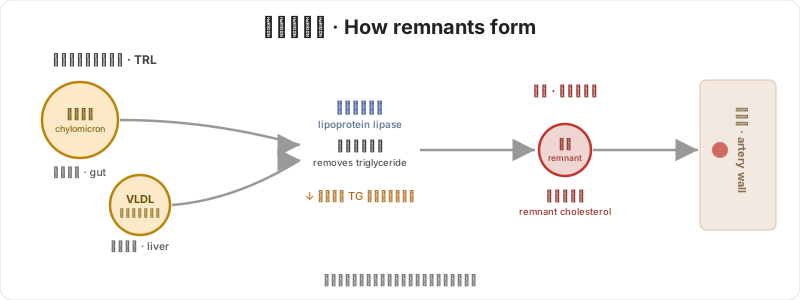
图 · 乳糜微粒(源于肠道)与 VLDL(源于肝脏)在脂蛋白脂肪酶作用下卸载甘油三酯,留下体积更小、相对富含胆固醇的残粒(即残粒胆固醇),可穿入动脉壁。[2]Tier 1Ginsberg, Henry N. et al. Triglyceride-rich lipoproteins and their remnants: metabolic insights, role in atherosclerotic cardiovascular disease, and emerging therapeutic strategies --- a consensus statement from the European Atherosclerosis Society. European Heart Journal 2021doi:10.1093/eurheartj/ehab551
残粒胆固醇:一个新兴的风险因素
残粒胆固醇(remnant cholesterol,remnant-C残粒胆固醇 · Remnant cholesterolremnant-C/ˈrɛmnənt kəˈlɛstərɒl/富含甘油三酯脂蛋白及其残粒(VLDL、IDL、乳糜微粒残粒等)所携带的胆固醇;临床上常粗略估算为“非 HDL-C 减去 LDL-C”,是新兴的动脉粥样硬化风险因素。The cholesterol carried within triglyceride-rich lipoproteins and their remnants (VLDL, IDL, chylomicron remnants); often crudely estimated as non-HDL-C minus LDL-C, it is an emerging atherosclerotic risk factor.🧩 词根拆解 / word rootsremnant残余、残粒(卸载甘油三酯后剩下的颗粒) · what remains (the particle left after unloading triglycerides)拉丁语 remanere 留下+chole-胆汁 · bile希腊语 kholē 胆汁+stere(o)-固体、坚硬 · solid/stiff希腊语 stereos 固体+-ol醇(化学后缀) · an alcohol (chemistry),缩写 remnant-C 或 RC) 指的就是这些富含甘油三酯脂蛋白及其残粒里所携带的胆固醇。[3]Tier 2Guan, Baoyi et al. Causal associations of remnant cholesterol with cardiometabolic diseases and risk factors: a mendelian randomization analysis. Cardiovascular Diabetology 2023doi:10.1186/s12933-023-01927-z 在实践中,它常被 粗略地估算为"非高密度脂蛋白胆固醇(non-HDL-C,即总胆固醇减去 HDL-C)再减去 LDL-C"。[2]Tier 1Ginsberg, Henry N. et al. Triglyceride-rich lipoproteins and their remnants: metabolic insights, role in atherosclerotic cardiovascular disease, and emerging therapeutic strategies --- a consensus statement from the European Atherosclerosis Society. European Heart Journal 2021doi:10.1093/eurheartj/ehab551
为什么要单独关注它?因为大量流行病学研究显示,升高的甘油三酯与富含甘油三酯脂蛋白(及其残粒) 与动脉粥样硬化性心血管疾病(atherosclerotic cardiovascular disease,ASCVD动脉粥样硬化性心血管疾病 · Atherosclerotic cardiovascular diseaseASCVD/ˌæθəroʊskləˈrɒtɪk ˌkɑːrdioʊˈvæskjələr/由动脉粥样硬化引起的一类疾病的总称,包括冠心病、缺血性卒中、外周动脉疾病等。An umbrella term for diseases caused by atherosclerosis, including coronary heart disease, ischaemic stroke, and peripheral artery disease.)风险 增加密切相关。[1]Tier 1Joint Committee for the Development of Chinese Guidelines for the Management of Blood Lipids et al. 2023 Chinese guideline for lipid management (English full text). Frontiers in Pharmacology 2023doi:10.3389/fphar.2023.1190934
更进一步,遗传学(孟德尔随机化)证据提示这不只是"相关",而可能是因果:一项汇集多国大型队列 的孟德尔随机化分析发现,遗传上更高的残粒胆固醇会因果性地升高缺血性心脏病、心肌梗死、外周动脉 疾病等的风险。[3]Tier 2Guan, Baoyi et al. Causal associations of remnant cholesterol with cardiometabolic diseases and risk factors: a mendelian randomization analysis. Cardiovascular Diabetology 2023doi:10.1186/s12933-023-01927-z 这与 2019 ESC/EAS 指南的立场一致——孟德尔随机化研究已证明 LDL-C 及其他富含胆固醇的含 apoB 脂蛋白(包括富含甘油三酯脂蛋白)与 ASCVD 存在因果关系。[4]Tier 1Mach, Francois et al. 2019 ESC/EAS guidelines for the management of dyslipidaemias: lipid modification to reduce cardiovascular risk. European Heart Journal 2020doi:10.1093/eurheartj/ehz455
为什么残粒会伤害血管
动脉粥样硬化(atherosclerosis,Atherosclerosis动脉粥样硬化 · Atherosclerosis/ˌæθəroʊskləˈroʊsɪs/含胆固醇的脂质与炎症细胞在动脉内膜沉积、逐渐形成斑块使管腔狭窄、血管壁变硬的慢性过程。A chronic process in which cholesterol-rich lipids and inflammatory cells accumulate in the arterial intima, gradually forming plaques that narrow the lumen and stiffen the vessel wall.🧩 词根拆解 / word rootsathero-粥样、脂糊状(指斑块柔软的脂质核) · gruel/porridge (the soft fatty core)希腊语 athērē 粥/糊+scler(o)-硬化、变硬 · hardening希腊语 sklēros 硬+-osis(病理性)状态、过程 · abnormal condition/process希腊语 -ōsis)的起点,是含 apoB 的脂蛋白颗粒穿过血管内皮、滞留在动脉壁内。[4]Tier 1Mach, Francois et al. 2019 ESC/EAS guidelines for the management of dyslipidaemias: lipid modification to reduce cardiovascular risk. European Heart Journal 2020doi:10.1093/eurheartj/ehz455 足够小的颗粒(直径约小于 70 纳米)可以主动穿过内皮、被截留在内皮下层,从而参与斑块的形成与进展—— 残粒正属于这类颗粒。[2]Tier 1Ginsberg, Henry N. et al. Triglyceride-rich lipoproteins and their remnants: metabolic insights, role in atherosclerotic cardiovascular disease, and emerging therapeutic strategies --- a consensus statement from the European Atherosclerosis Society. European Heart Journal 2021doi:10.1093/eurheartj/ehab551
还有一点让残粒格外"危险":与普通 LDL 需要先被氧化修饰不同,富含胆固醇的残粒颗粒无需结构改造 就能被巨噬细胞吞噬,并由此引发炎症反应,进一步推动动脉粥样硬化。[2]Tier 1Ginsberg, Henry N. et al. Triglyceride-rich lipoproteins and their remnants: metabolic insights, role in atherosclerotic cardiovascular disease, and emerging therapeutic strategies --- a consensus statement from the European Atherosclerosis Society. European Heart Journal 2021doi:10.1093/eurheartj/ehab551
别忽视"残余风险"
即使把 LDL-C 降得很好,风险也未必"清零"。EAS 共识指出,升高的甘油三酯(伴随 TRL 与残粒颗粒的 堆积)不仅在未用他汀、看似健康的人中独立于 LDL-C 与亚临床动脉粥样硬化及血管炎症相关,也与已用 他汀治疗者的残余心血管风险相关,尤其是合并糖尿病的患者。[2]Tier 1Ginsberg, Henry N. et al. Triglyceride-rich lipoproteins and their remnants: metabolic insights, role in atherosclerotic cardiovascular disease, and emerging therapeutic strategies --- a consensus statement from the European Atherosclerosis Society. European Heart Journal 2021doi:10.1093/eurheartj/ehab551 这正是残粒胆固醇 作为"新兴风险因素"受到重视的原因。
怎么测,要不要空腹
过去测血脂强调空腹。但就评估心血管风险而言,非空腹甘油三酯并不逊色,甚至可能更好;真实世界里 随机非空腹(餐后)TG 平均比空腹值高约 20%–25%。[2]Tier 1Ginsberg, Henry N. et al. Triglyceride-rich lipoproteins and their remnants: metabolic insights, role in atherosclerotic cardiovascular disease, and emerging therapeutic strategies --- a consensus statement from the European Atherosclerosis Society. European Heart Journal 2021doi:10.1093/eurheartj/ehab551 也就是说,非空腹抽血同样 能提供有用的风险信息。
甘油三酯的常用分层参考值(空腹,单位 mmol/L)方面,《中国血脂管理指南(2023)》给出:[1]Tier 1Joint Committee for the Development of Chinese Guidelines for the Management of Blood Lipids et al. 2023 Chinese guideline for lipid management (English full text). Frontiers in Pharmacology 2023doi:10.3389/fphar.2023.1190934
- 合适水平:< 1.7 mmol/L(约 150 mg/dL)
- 边缘升高:1.7 – 2.3 mmol/L
- 升高:≥ 2.3 mmol/L(约 200 mg/dL)
此外,当空腹 TG > 3.4 mmol/L 时,血清可呈乳白色浑浊。[1]Tier 1Joint Committee for the Development of Chinese Guidelines for the Management of Blood Lipids et al. 2023 Chinese guideline for lipid management (English full text). Frontiers in Pharmacology 2023doi:10.3389/fphar.2023.1190934 对于心血管高风险 人群,若 TG > 2.3 mmol/L,指南建议进行相应处理。[1]Tier 1Joint Committee for the Development of Chinese Guidelines for the Management of Blood Lipids et al. 2023 Chinese guideline for lipid management (English full text). Frontiers in Pharmacology 2023doi:10.3389/fphar.2023.1190934(mg/dL 为按常用系数 换算的近似值,具体请以化验单标注的单位与参考区间为准。)
小结
- 甘油三酯由乳糜微粒(膳食脂肪)和 VLDL(肝脏合成)运输,统称富含甘油三酯脂蛋白。[2]Tier 1Ginsberg, Henry N. et al. Triglyceride-rich lipoproteins and their remnants: metabolic insights, role in atherosclerotic cardiovascular disease, and emerging therapeutic strategies --- a consensus statement from the European Atherosclerosis Society. European Heart Journal 2021doi:10.1093/eurheartj/ehab551
- 这些颗粒卸载甘油三酯后变成"残粒",其中相对富集胆固醇,即残粒胆固醇。[2]Tier 1Ginsberg, Henry N. et al. Triglyceride-rich lipoproteins and their remnants: metabolic insights, role in atherosclerotic cardiovascular disease, and emerging therapeutic strategies --- a consensus statement from the European Atherosclerosis Society. European Heart Journal 2021doi:10.1093/eurheartj/ehab551
- 残粒胆固醇是一个新兴风险因素:遗传学证据提示它与 ASCVD 存在因果关系,且残粒可穿入动脉壁、被 巨噬细胞吞噬并引发炎症。[3]Tier 2Guan, Baoyi et al. Causal associations of remnant cholesterol with cardiometabolic diseases and risk factors: a mendelian randomization analysis. Cardiovascular Diabetology 2023doi:10.1186/s12933-023-01927-z[2]Tier 1Ginsberg, Henry N. et al. Triglyceride-rich lipoproteins and their remnants: metabolic insights, role in atherosclerotic cardiovascular disease, and emerging therapeutic strategies --- a consensus statement from the European Atherosclerosis Society. European Heart Journal 2021doi:10.1093/eurheartj/ehab551
- 即便 LDL-C 达标,升高的甘油三酯/残粒仍可能带来"残余风险",值得和医生一起关注。[2]Tier 1Ginsberg, Henry N. et al. Triglyceride-rich lipoproteins and their remnants: metabolic insights, role in atherosclerotic cardiovascular disease, and emerging therapeutic strategies --- a consensus statement from the European Atherosclerosis Society. European Heart Journal 2021doi:10.1093/eurheartj/ehab551
⚕️ 本内容仅供健康科普与学习,不能替代专业医疗建议、诊断或治疗。
参考文献 / References
- Tier 1Joint Committee for the Development of Chinese Guidelines for the Management of Blood Lipids et al. 2023 Chinese guideline for lipid management (English full text). Frontiers in Pharmacology (2023) · doi:10.3389/fphar.2023.1190934
- Tier 1Ginsberg, Henry N. et al. Triglyceride-rich lipoproteins and their remnants: metabolic insights, role in atherosclerotic cardiovascular disease, and emerging therapeutic strategies --- a consensus statement from the European Atherosclerosis Society. European Heart Journal (2021) · doi:10.1093/eurheartj/ehab551
- Tier 2Guan, Baoyi et al. Causal associations of remnant cholesterol with cardiometabolic diseases and risk factors: a mendelian randomization analysis. Cardiovascular Diabetology (2023) · doi:10.1186/s12933-023-01927-z
- Tier 1Mach, Francois et al. 2019 ESC/EAS guidelines for the management of dyslipidaemias: lipid modification to reduce cardiovascular risk. European Heart Journal (2020) · doi:10.1093/eurheartj/ehz455